

Introduction
With the market full of SSDs for a consumer to choose from, it is difficult to make make a decision for the right choice. In the consumer market, SSDs come with SATA 6Gbps interface, but we are reaching a point where 6Gbps is not enough for the speeds of a SATA drive. Faster solid state drives can be manufactured and technology already allows speeds beyond the current flagship SSDs. Yet, the industry is still looking for a faster SATA interface to enable this technology. Current SATA 6Gbps speeds can theoretically give a maximum of read and write speed of up to 750MB/s. Samsung 840 Pro are already reaching 500++ MB/s on their drives, which is actually near the saturation of the interface.That is why ASUS decided to release a speed demon. Their new RAIDR Express SSD requires a PCI-e interface instead of the usual SATA 6Gbps. This allows the SSD to attain crazy speeds of up to 1GB/s/ This means it is around 30% faster than the current SATA 6Gbps interface. Of course, with the use of a faster interface, one can expect that the SSD will be rated over 750MB/s. In fact, it does.

Specifications
The Asus ROG RAIDR Express is aimed at “hardcore gamers and PC enthusiasts demanding a more reliable computer experience.”
Controller
|
Dual LSI SandForce SF-2281 controllers
|
Flash Memory
|
Toshiba 19nm 16K Page Size MLC Sync- NAND Flash
|
Performance
|
Sequential Read : 830MB/s
Sequential Write: 810MB/s
4K Read IOPS : Up to 100,000 IOPS
4K Write IOPS: Up to 100,000 IOPS
Latency:
|
OS Support
|
Windows 7
Windows 8
|
Reliability
|
MTBF: 620,000 Hours
Data Encryption: 128bit AES
Data Reliability:
|
Features
|
UEFI Boot Compliant
Windows 8 Secure Boot Supported
AHCI Compliant
Exclusive Features :
·
RAMDIsk
·
SSD TweakIt
·
ROG HybriDisk
·
Secure Erase
·
Kapersky Anti-Virus 2013
|
ASUS has made the SSD much more user friendly and a lot more "consumer-focused". One of the core features is the ability for users to install Windows 8 or Windows 7 directly from on the PCI-e based SSD. It was previously difficult to make a PCI-e based SSD drive bootable. Additionally, with support for Windows 8 Secure Boot, you can make sure that boot speeds are reduced and security of the whole system is improved.
 |
| Top of card lights up red |
Features
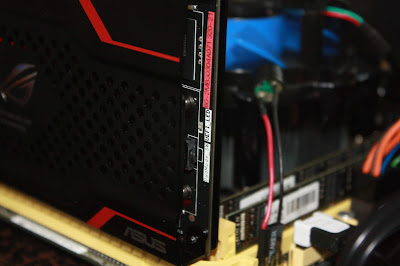
DuoMode BIOS
ASUS has branded the RAIDR Express SSD as a "First legacy and UEFI compatible PCIe SSD". This means many benefits to the end user who wants to install Windows 8 on their system. As you many know, Microsoft integrated a new way to boot into Windows with the new UEFI compatible BIOS. The process called Secure Boot only allows devices with a signed driver approved by Microsoft to boot and be initialized. This means that there could be a lot of compatibility issues with older hardware which are not made for Windows 8. Thanks to ASUS which has included a switch to toggle the SSD drive between Legacy mode and UEFI Secure Boot mode, compatibility with any motherboard and system is maximized. Therefore, buyers need not worry too much that this SSD will not work with their system. Little work will need to be done to get started with installation of OS on RAIDR Express.

Secure Erase

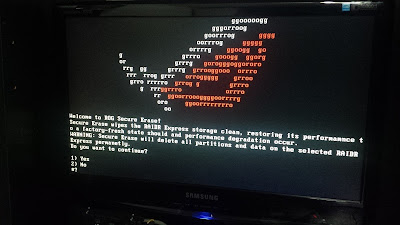
Included in the box is a driver CD which is also actually a bootable Linux OS that loads ROG's Secure Erase software. In order to restore the SSD into its factory speeds, one needs to run Secure Erase and recondition the whole SSD. We were glad that the processor was fairly simple and that Secure Erase completed very quickly. However, ROG Secure Erase only works with RAIDR Express and not any other SSDs. If only ASUS made it available to the public to work with any other SSD, I believe that this will become a popular tool that people will use.
How did RADIR Express get such high speeds?

Looking deeper into the specifications of RAIDR Express, we realised that it was very different from your usual SSD. In order to get the best speeds from this PCI-Express card, the SSD is in fact 2 different physical SSDs put into a RAID 0 configuration. This essentially boosts the performance of the SSD by 2 times by striping data across both drives. Each drive has 120GB of space and it has a onboard marvell storage controller which handles the RAID configuration. In windows, you will see it as one single SSD.
Test Setup

- ASUS Z87I-Pro
- Intel Core i7 4770K at stock speeds
- Samsung Black Knight 2x4GB 1600MHz DDR3 RAM
- Samsung 840 120GB as OS SSD
- ASUS RAIDR Express 240GB SSD
Benchmarks
Anvil Storage Utilities

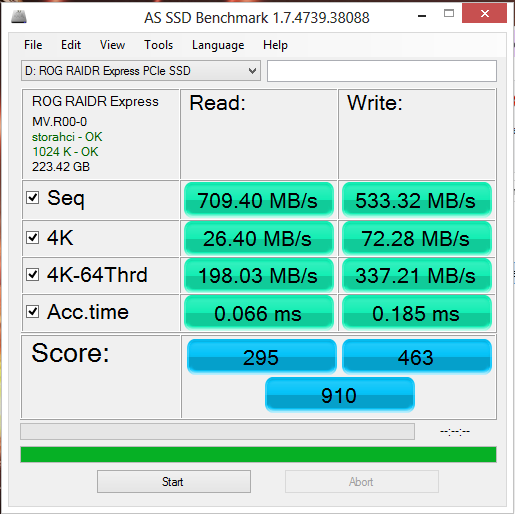
AS SSD
CrystalDiskMark

ATTO

Conclusion
It was sad that we weren't able to reproduce the speeds as specified by ASUS which was at sequential speeds of 830MB/s Read and 810MB/s Write. However, it was definitely worth the note that the ATTO benchmark indeed did come close to the specified speeds at 780MB/s. We thought that it was possible that the SSDs were a bit overrated as we tried our best to match up the speeds. We did a secure erase before all the benchmarks and also enabled all the tweaks which ASUS SSDTweakIt recommended.Nevertheless, speeds on the ASUS RAIDR Express beats any single SATA 6Gbps SSD hands down. It got speeds over the limit of what SATA 6Gbps can offer and it is definitely a speed demon as what ASUS calls it. There is currently no pricing released for the Singapore market, but it is sold in Japan for 39,980 Yen (520SGD). We thought that the SSD is probably worth that amount of money due to its speeds, but such performance can easily be triumphed over by two top end SSDs in RAID0 configuration, and still yet be cheaper than 520SGD.
ASUS RAIDR Express will be a good buy for those looking for a PCI-e based SSD as it is one of the cheapest PCIe SSD out there. Providing speeds of well over 700MB/s, we thought that this edition makes sense if you are running out of SATA ports, or if you like the aesthetics of the card and the swag it provides to your overall looks of the system build.
For the LATEST tech updates,
FOLLOW us on our Twitter
LIKE us on our FaceBook
SUBSCRIBE to us on our YouTube Channel!