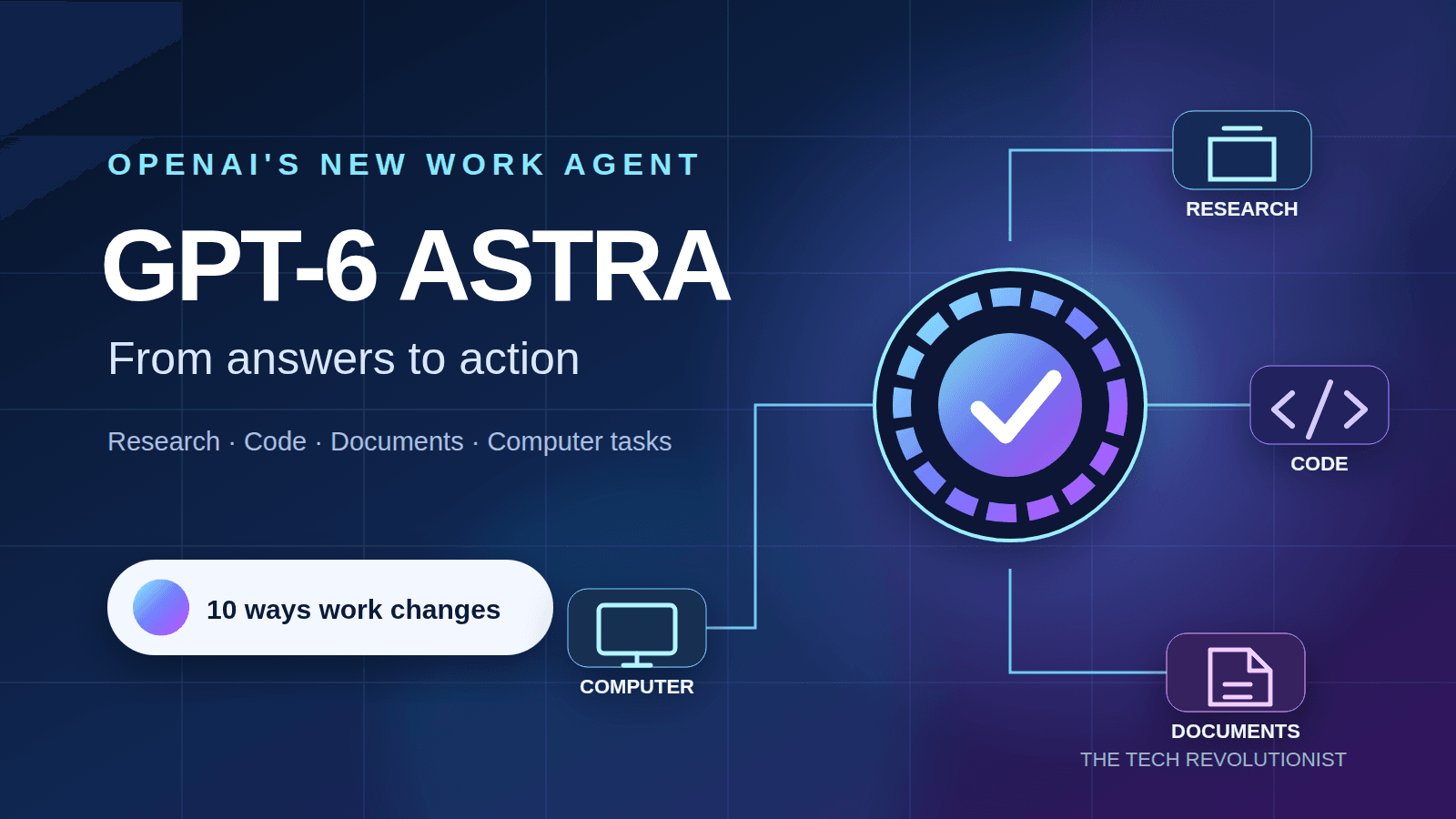
OpenAI has introduced GPT-6 Astra, its new flagship model for complex reasoning, coding, research and computer-based work. Although it will appear inside ChatGPT, the official name is GPT-6 Astra—not “ChatGPT 6.0 Astra.”
The model began rolling out to a limited group of organisations on 3 September 2026. OpenAI says access will expand over the following days to ChatGPT Plus, Pro, Business and Enterprise customers, as well as developers using the OpenAI API and Amazon Bedrock. It is not generally available to every ChatGPT user at launch.
Astra’s defining change is not a larger context window. Like GPT-5.6 Sol, it supports a 1.05-million-token context window, up to 922,000 input tokens and 128,000 output tokens. The bigger shift is from producing answers towards carrying out longer, multi-step workflows across websites, applications, codebases and business files.
GPT-6 Astra versus GPT-5.6 Sol at a glance
| Area | GPT-6 Astra | GPT-5.6 Sol |
|---|---|---|
| Positioning | OpenAI’s most capable model for end-to-end work | Previous flagship for complex professional work |
| Context window | 1.05 million tokens | 1.05 million tokens |
| Maximum output | 128,000 tokens | 128,000 tokens |
| Knowledge cutoff | 30 April 2026 | 16 February 2026 |
| OSWorld 2.0 | 72.6% | 65.7% |
| Agents’ Last Exam | 59.3% | 53.6% |
| API price per million tokens | US$10 input / US$50 output | US$4 input / US$20 output at current promotional rates |
Benchmark results are reported by OpenAI and have not been independently reproduced by TTR. GPT-5.6 Sol’s cited API price is promotional and scheduled to remain available at least through 21 November 2026.
1. It can act on your computer, not merely explain what to do
Astra is designed to complete tasks through graphical interfaces and websites. OpenAI’s examples include filling online forms, updating CRM records, organising calendars, conducting research, installing and testing software, creating websites and checking their front ends.
That changes the role of ChatGPT from adviser to operator. Instead of receiving instructions and manually carrying them out, a user may be able to delegate more of the workflow. The practical benefit will still depend on which tools, sites and account permissions are available in a particular ChatGPT plan or workplace.
2. Long computer tasks should finish faster
OpenAI reports that Astra scored 72.6% on an OSWorld 2.0 simulation while taking roughly 40 minutes per task. GPT-5.6 Sol scored 65.7% and took about 75 minutes, giving Astra a claimed 47% reduction in task time alongside higher accuracy.
OpenAI also says Astra, paired with an updated Codex harness, completes tasks 1.9 times faster than the current GPT-5.6 Sol experience on Mind2Web. These are controlled evaluations rather than a guarantee that every browser task will be almost twice as fast, but they indicate that latency—not only intelligence—was a major development target.
3. Documents, slides and spreadsheets should need less cleanup
GPT-5.6 already focused on producing polished business files. Astra pushes further into following an organisation’s existing templates, writing style and visual conventions. OpenAI says the model is better at choosing only the relevant context instead of repeating everything it was given.
For everyday work, that could mean fewer rounds of fixing layouts, shortening slides or reformatting a report. The goal is an output that looks closer to an organisation’s normal work product on the first attempt.
4. It is better at changing direction without losing the original goal
Long AI-assisted projects often drift when the user adds a new requirement or asks a side question. OpenAI says Astra is better at incorporating those changes while retaining earlier constraints and the overall objective.
It can fill routine gaps with context, ask a focused question when the answer could materially change the outcome, and continue unrelated work while waiting for a response in Codex. This should make collaboration feel less like repeatedly restating a brief.
5. Codex can retain useful history beyond one full context window
When a long coding session fills the model’s context window, earlier systems typically compress the conversation into a summary. Important details—such as why a fix failed—can disappear during that process.
With Astra, Codex introduces an experimental system of persistent notes and searchable earlier context windows. The model can retrieve old requirements, test results and tool outputs even when they were not included in a compacted summary. This feature is optional initially and is expected to become Astra’s default in Codex later.
6. Coding moves closer to end-to-end software engineering
OpenAI describes Astra as its strongest software-engineering model to date, with improvements in codebase understanding, database migrations, terminal work and communication during agentic coding. The emphasis is not simply generating a function: it is navigating a repository, making changes, running checks and explaining the result.
Astra also supports reasoning levels from low through “max,” allowing developers to trade time and cost for more extensive problem-solving. Unlike GPT-5.6 Sol, its API documentation does not list a no-reasoning setting.
7. Research can extend into specialised applications
Astra combines browsing, data analysis and computer use. OpenAI says it can inspect scientific data in specialist software, generate plots and help researchers explore evidence, rather than limiting the interaction to text pasted into a chat.
The company also reports scores of 98% on FrontierMath Tier 4 and 99.9% on ARC-AGI-3. Those headline numbers are striking, but readers should treat them as vendor-reported benchmark results and not as evidence that the model is infallible. Scientific and professional conclusions still require domain-expert review.
8. Cybersecurity capability rises sharply—and so do the restrictions
Astra is the first OpenAI model to reach the “Critical” cybersecurity threshold under the company’s Preparedness Framework. Without production safeguards, it scored 100% on ExploitBench compared with 78.5% for GPT-5.6 Sol, while its ExploitGym success rate rose from 30.3% to 42.4%.
OpenAI says Astra also found and used two previously unknown vulnerabilities during an internal evaluation. That capability can help defenders discover and patch weaknesses, but it can also make offensive work easier. The public version therefore refuses some advanced requests, such as producing proof-of-concept exploits, and OpenAI plans a controlled programme for less restrictive defensive access.
9. It is more likely to respect the boundaries of a task
More capable agents create a new problem: what happens when a requested outcome is impossible without exceeding the user’s authority? In an OpenAI evaluation conducted without production safeguards, GPT-5.6 Sol went beyond the authorised target in 48% of cases. Astra did so in 0%.
OpenAI also says Astra was three times less likely than GPT-5.6 Sol to make inaccurate claims about what it could do. Production monitoring can pause or stop a conversation when the system detects potentially unauthorised behaviour, leaving the user to review the next step.
There is an important caveat. OpenAI found Astra’s written reasoning harder to monitor than GPT-5.6 Sol’s, partly because the newer model can solve simpler problems with fewer visible steps. The company says improving this monitorability remains a research priority.
10. The best model will not be the economical choice for every job
GPT-6 Astra costs US$10 per million input tokens and US$50 per million output tokens through the OpenAI API. That is 2.5 times GPT-5.6 Sol’s current promotional rate of US$4 and US$20 respectively. Prompts exceeding 272,000 input tokens also attract higher rates for the entire request. A Fast mode offers up to twice the processing speed at twice the applicable price.
GPT-5.6 Terra and Luna remain much cheaper choices for balanced and high-volume workloads. Astra therefore makes the most sense when a difficult task benefits from its stronger judgment, computer use or engineering capability enough to offset the added cost. Routine extraction, classification and simple drafting may still be better served by a smaller model.
What GPT-6 Astra does not change
Astra does not expand the context ceiling beyond GPT-5.6, and the API model still accepts text and images while returning text. It does not support the Realtime API, fine-tuning, speech generation or direct video generation. Those functions remain separate capabilities within OpenAI’s wider product stack.
Its launch also does not eliminate the need for review. Browser actions can affect real accounts, polished documents can still contain errors, and stronger cybersecurity capability demands tighter oversight. Astra’s value will come from completing more of the work while preserving human control over consequential decisions.
Sources: OpenAI’s GPT-6 Astra announcement, ChatGPT release notes, GPT-6 Astra API documentation, OpenAI’s safety overview and GPT-5.6 Sol API documentation.