NVIDIA is adding a 64GB version of its DGX Spark personal AI computer, lowering the entry price for developers who want to run models and agents locally while retaining the option to link two systems for larger workloads.
The new configuration keeps the GB10 Grace Blackwell Superchip, DGX OS and NVIDIA AI software stack used by the 128GB model. NVIDIA says it will be available from Acer, ASUS, Dell, Gigabyte, HP and MSI from 23 October, starting at US$4,999. Singapore pricing and availability have not been announced.
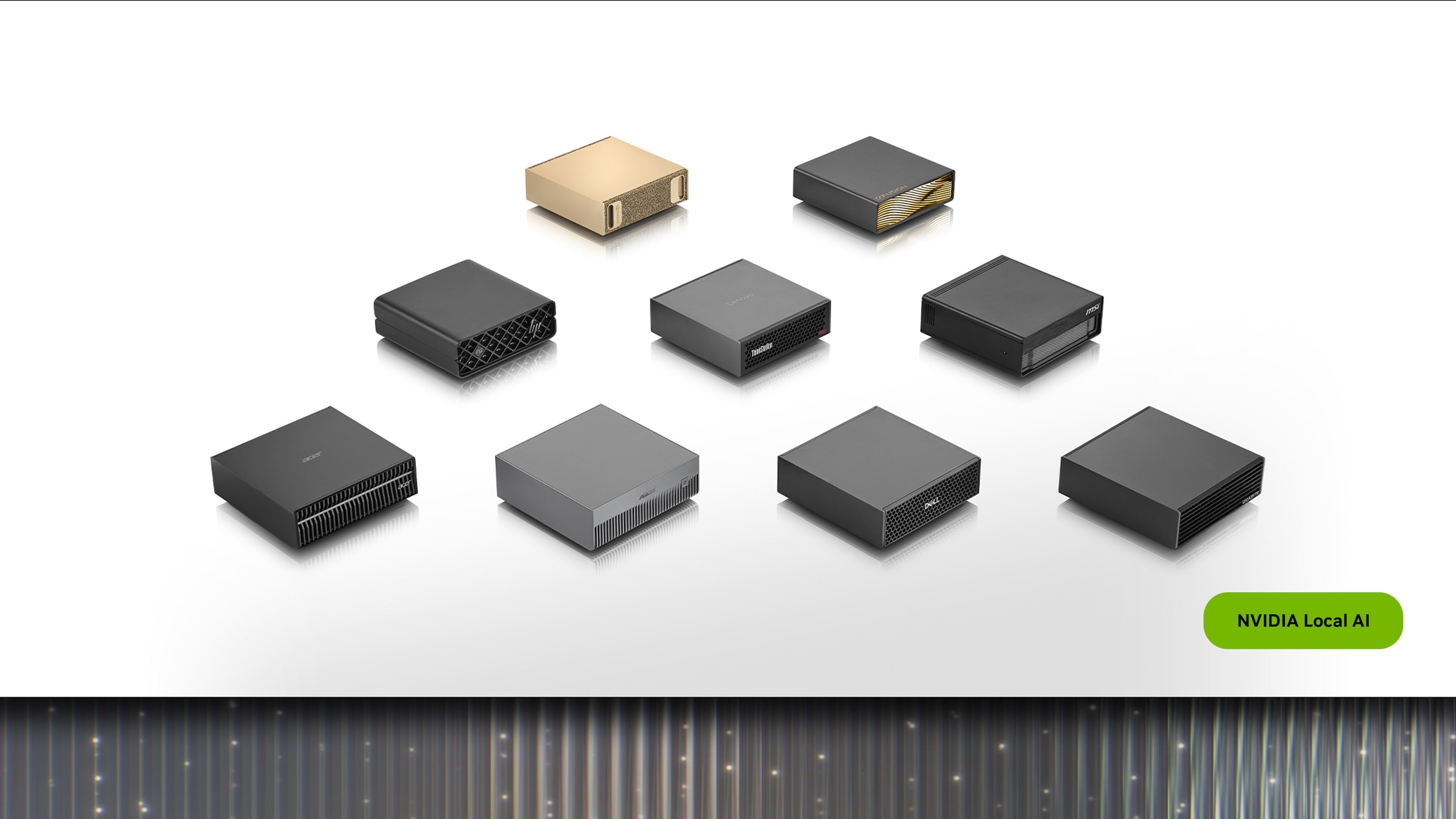
Same GB10 platform with half the unified memory
DGX Spark combines the Arm-based Grace CPU and Blackwell GPU in the GB10 Superchip with unified system memory, a ConnectX-7 network interface and NVIDIA's CUDA-accelerated software stack. The 64GB model is positioned as a lower-cost starting point for inference, fine-tuning, data science and agent development.
According to NVIDIA, one 64GB system can run models with up to 100 billion parameters. That figure describes the platform's claimed model-capacity ceiling rather than a guarantee that every model of that size will deliver useful speed or fit once context, key-value cache and application overhead are included.
The supported software environment includes NVIDIA Agent Toolkit and CUDA-X libraries alongside popular tools such as Ollama, vLLM and PyTorch with CUDA. NVIDIA also says a prebuilt Blender installer for DGX Spark is coming soon.
NVIDIA Sync links two DGX Spark systems
The accompanying NVIDIA Sync Cluster Assistant is designed to simplify a two-node setup. Users connect two DGX Spark units directly through their ConnectX-7 ports with a QSFP cable, after which the software detects the systems, checks their configuration and prepares the network.
Two 64GB units provide 128GB of combined memory over a 200GbE fabric. NVIDIA says the arrangement can support models with up to 200 billion parameters and provides twice the memory bandwidth of one system.
In NVIDIA's own test with Qwen3.8 27B, two clustered 64GB systems delivered up to 1.7 times the performance of one system. NVIDIA has not published enough methodology in the announcement to treat that figure as a general scaling result, and performance will vary with the model, runtime, quantisation, context length and workload.
NVIDIA Sync Model Launcher is due at the end of October. The company says it will offer a guided way to download and run Qwen3.8 27B on one DGX Spark or across a two-system cluster, expose the model to a user's laptop and configure OpenCode for browser-based coding workflows.
Local AI without removing infrastructure trade-offs
The 64GB model is aimed at developers who want agents and AI applications to stay on their own hardware, whether for continuous availability, data control or reduced dependence on cloud instances. A single DGX Spark can handle a model while a separate everyday laptop or desktop runs the user-facing application.
The two-system path adds capacity without changing software environments between nodes, but it also doubles the hardware purchase and introduces cabling, power and multi-node efficiency considerations. At the announced starting price, a pair would cost at least US$9,998 before accessories, taxes or regional mark-ups.
The new SKU therefore broadens the DGX Spark range rather than replacing the 128GB version. Buyers will need to compare the memory required by their actual models and context windows against the cost and operational simplicity of one larger-memory system, two clustered units or rented cloud capacity.
More details are available in NVIDIA's official Local AI announcement. TTR has not tested the 64GB DGX Spark or independently verified NVIDIA's performance claims.
Source: NVIDIA Local AI blog post dated 2 October 2026 and press material distributed by CIZA Concept for NVIDIA.