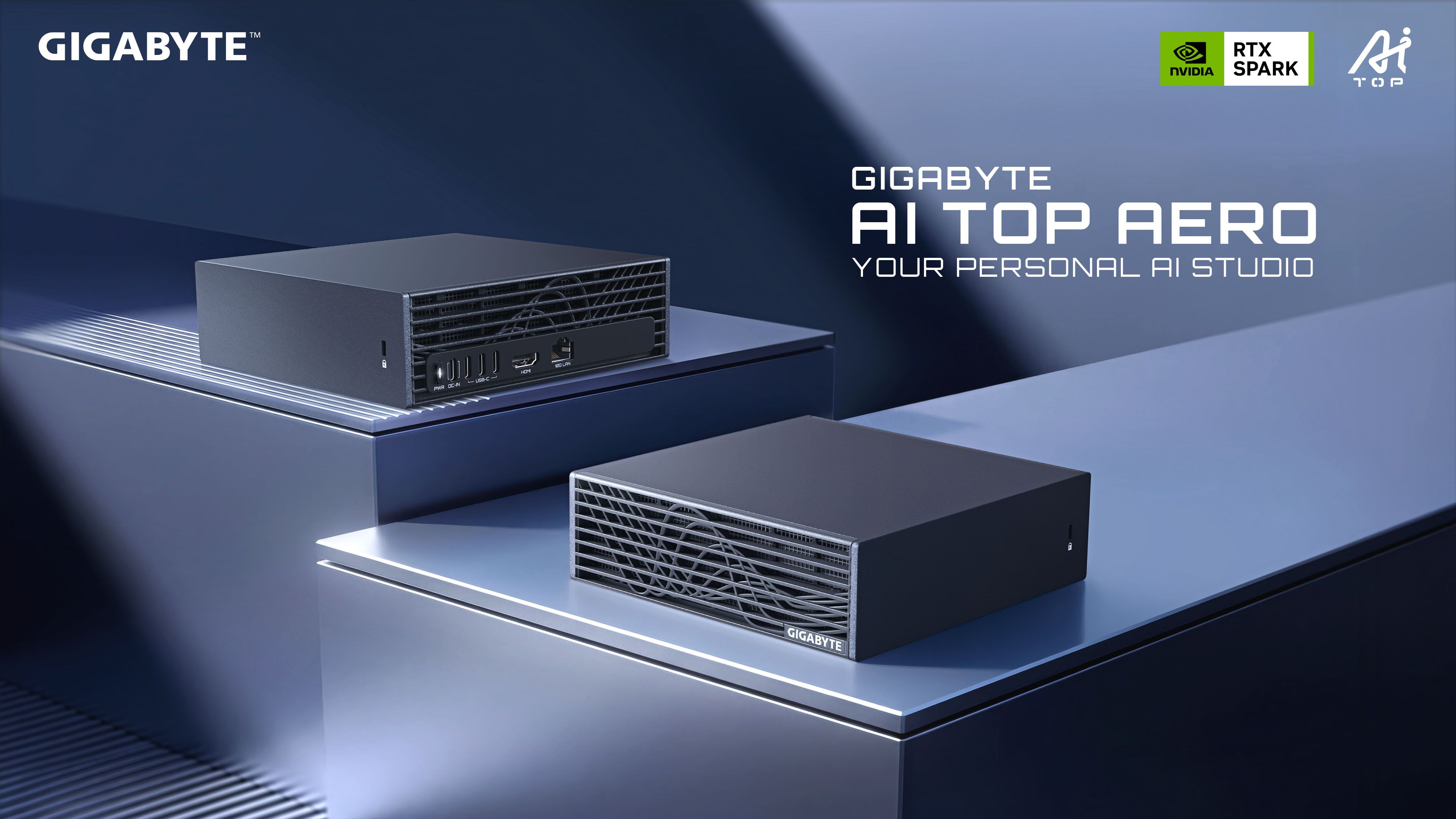
GIGABYTE has introduced the AI TOP AERO, a compact Windows 11 desktop built around NVIDIA’s new RTX Spark platform. The roughly one-litre system combines a 20-core NVIDIA Grace CPU, a Blackwell-generation RTX GPU and up to 128GB of unified memory, targeting developers and creators who want to run AI workloads locally without dedicating space to a conventional workstation tower.
The company describes AI TOP AERO as a “Personal AI Studio” that can move among model development, generative-media workflows and supported games. GIGABYTE announced the system on 10 November 2026, but pricing, region-specific configurations and retail availability have not yet been disclosed.
RTX Spark N1X combines Grace and Blackwell
At the centre of AI TOP AERO is the NVIDIA RTX Spark N1X Superchip. According to GIGABYTE, it integrates a 20-core NVIDIA Grace CPU with a Blackwell RTX GPU and uses a unified-memory architecture, allowing the processor and graphics hardware to work from the same memory pool.
Configurations will offer up to 128GB of LPDDR5x unified system memory and as much as 4TB of PCIe Gen5 SSD storage. That memory capacity is the key differentiator for local AI work: it can accommodate models and working data that would exceed the dedicated graphics memory available on many conventional desktop GPUs. Actual model compatibility and performance will still depend on precision, quantisation, context length, software support and the rest of the workload.
The system runs Windows 11 rather than a specialised appliance operating system. GIGABYTE says this gives users access to familiar desktop applications while retaining CUDA and RTX acceleration for compatible AI, creative and gaming software.
A one-litre chassis designed for sustained workloads
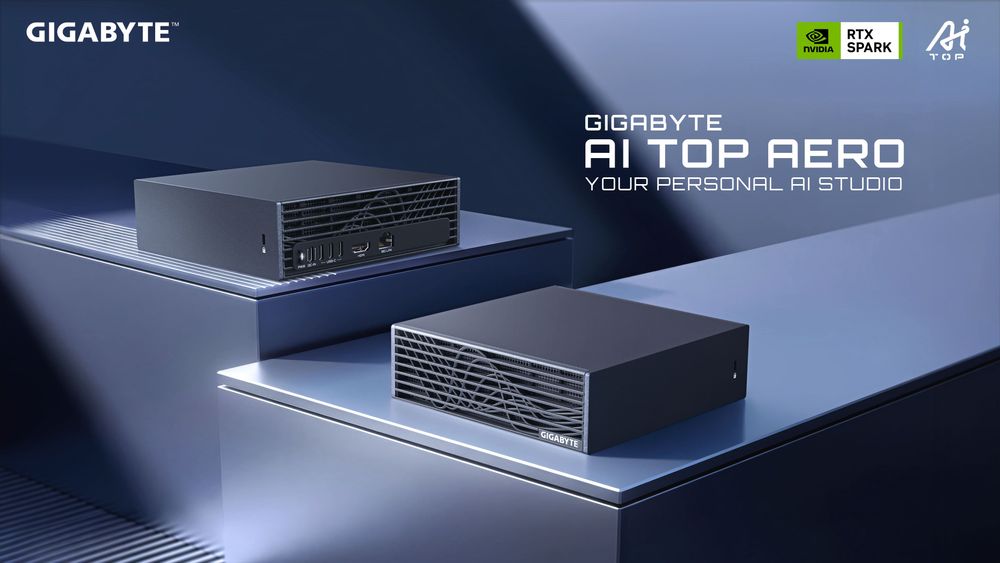
Packaging this class of hardware into an enclosure of approximately one litre creates a thermal challenge, particularly when AI inference, content generation or rendering keeps the processor and GPU busy for extended periods. GIGABYTE says it has applied its own cooling and system-integration design to provide enough thermal headroom for sustained work, although the company has not released independent performance or acoustic measurements.
The supplied product image shows a heavily vented front panel and a compact rectangular enclosure intended for a desk, studio or office. Connectivity listed by GIGABYTE includes USB Type-C, 10GbE Ethernet and Wi-Fi 7. Exact port counts, display outputs and wireless specifications may vary by configuration and region, so prospective buyers should check the final local specification sheet.
Local models, agents and networked inference
GIGABYTE is positioning AI TOP AERO for developers who want to prototype, fine-tune and run open models on their own hardware. The software stack includes NVIDIA CUDA support and compatibility with NVIDIA Nemotron models, while commonly used local-AI tools such as LM Studio and Ollama are named as options for building and testing local inference workflows.
Keeping inference on the PC can reduce dependence on a cloud connection and give users more direct control over where their prompts, documents and model outputs are processed. It does not make every workflow automatically private: applications can still contact external services, and users remain responsible for software settings, network access and data handling.
The platform also supports NVIDIA PAIR, short for Personal AI Router. GIGABYTE says PAIR can distribute inference tasks among available devices on a local network, potentially letting a home or studio use AI TOP AERO as part of a broader pool of compute resources. The practical benefit will depend on application support, network performance and how workloads are divided.
Creative tools and DLSS 5 gaming
For creators, GIGABYTE highlights compatibility with ComfyUI for node-based generative-AI workflows, along with NVIDIA Broadcast and RTX Video technologies for supported audio and video processing. The unified memory pool may be useful when a workflow combines a large model with high-resolution assets, though real-world throughput has not yet been independently tested.
AI TOP AERO is also presented as a gaming-capable PC. Its Blackwell RTX GPU supports NVIDIA DLSS 5 in compatible titles, allowing the same machine to switch between local AI work, content creation and entertainment. GIGABYTE has not provided conventional GPU-class comparisons, game benchmarks or power figures, so its gaming position cannot yet be judged against a discrete desktop graphics card.
Availability remains regional
GIGABYTE says AI TOP AERO launched on 10 November 2026, with configurations, pricing and availability to be announced by its regional operations. Buyers should wait for local SKU details before assuming that the maximum 128GB memory and 4TB storage configuration will be offered in every market.
More information will be published through the GIGABYTE newsroom and the company’s global website. All specifications and capability statements above are manufacturer claims from GIGABYTE’s launch material; The Tech Revolutionist has not tested the system.