
Path of Exile is an Action RPG with a diablo-esque style to it that's hard to miss if you were into Diablo II (Yes II, not III). It is created by a company called Grinding Gear Games, founded in 2006 by a group of university graduates mostly from New Zealand. They haven't really done anything and Path of Exile is their first title to be commercially released. This was a game running in closed beta for most of last year and didn't receive much attention due to larger titles overshadowing it such as Torchlight II and of course, Diablo III. So how is Path of Exile looking currently? After playing through most of it in the closed beta phase and looking back at the current status of the game, one can say that the game has gone through some changes both in story and gameplay. Let's take a look at some of the highlights now, shall we ?
Classes
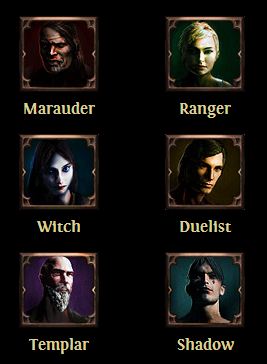
So exactly what can you play as in Path of Exile? There are 6 classes available in the current Open Beta - the Marauder, the Ranger, the Witch, the Duelist, the Templar and the Shadow. Each of these classes does something different. The first three are pretty standard and go purely into Strength, Dexterity and intelligence. The duelist is a Strength and Dexterity hybrid, the Templar is a Strength and Intelligence hybrid and the shadow is a Dexterity and Intelligence hybrid. The marauder deals with heavy weapons primarily. Rangers obviously use bows and arrows. Witches usually use wands. Duelists tend to dual wield and use two one handed weapons. Templars primarily use staffs and shadows prefer to use claws. Now this is fine but path of exile does not restrict the player from playing however he/she wants to. You could play a witch and run around with an axe chopping the forces of darkness apart as long as you have the desired stats needed to use the weapon.
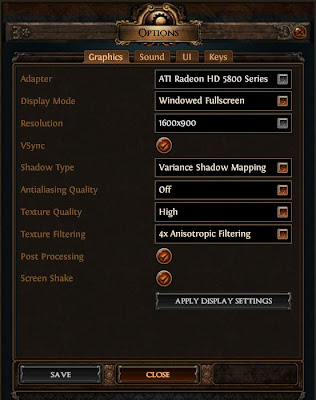
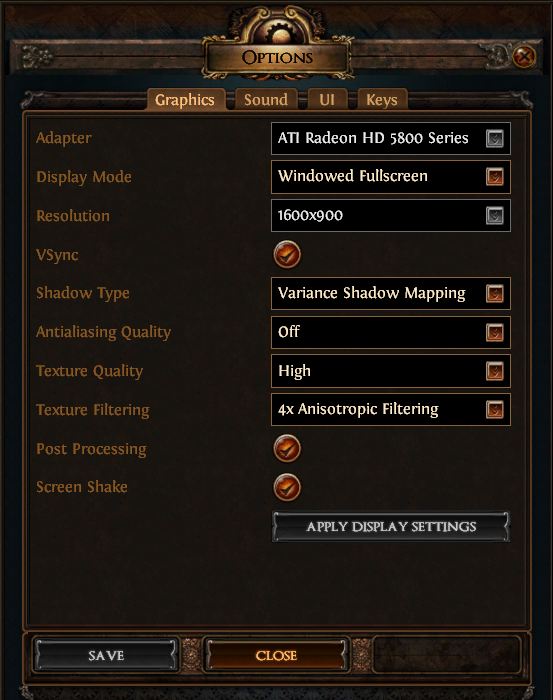
Most PC games fall into the common trappings of having horrible PC menus and settings. This mostly comes from them having to build the game for the console and then looking at a later PC port. However, Path of Exile was built for PC and always intended for PC. Settings-wise, it actually is quite decent. The game runs at a smooth 60 frames per second for me on high quality graphics using my Raedon 5850 card. There are also options to reduce map transparency should it get in the way too much, options to auto-equip on looting, an option to hide global chat which is always very useful and many more. It is clear that a lot of thought has gone into the creation of this game and it show not just in the game itself but also in the options menu alone.
PC Optimization
Presentation
Path of Exile is a very beautiful game. Textures are very well designed layouts are very varied. You go from stormy shores to abandoned temples to sandy beaches and even to jungles. There are so many different landscapes to look at in this dark game that it's actually pretty comparable to some of the games you normally have to pay for such as Diablo III. Maps are pretty huge too. They can really take quite some time to explore and fully flesh out with rich and vibrant backgrounds.
Skill animations feel good and enemy characters can be kind of generic (skeleton archer, skeleton melee warrior, skeleton - you get the point) but things are spiced up with the interesting way the bosses fight. For example, Brutus, the Prison Guard you fight in Act One, actually has a meat hook ability which most dota players will find incredibly reminiscent of pudge, the butcher.
There will be occasional rare monsters that glow in gold and monsters with a red-orange glow about them and a larger health bar over their heads, signifying that they are unique monsters that are quest related and always spawn in the same area. Most of these monsters tend to have specific monster auras about them that do different things. Our golden monkey above, for example, increases critical strike chance and damage and a whole other bunch of passives / actives.
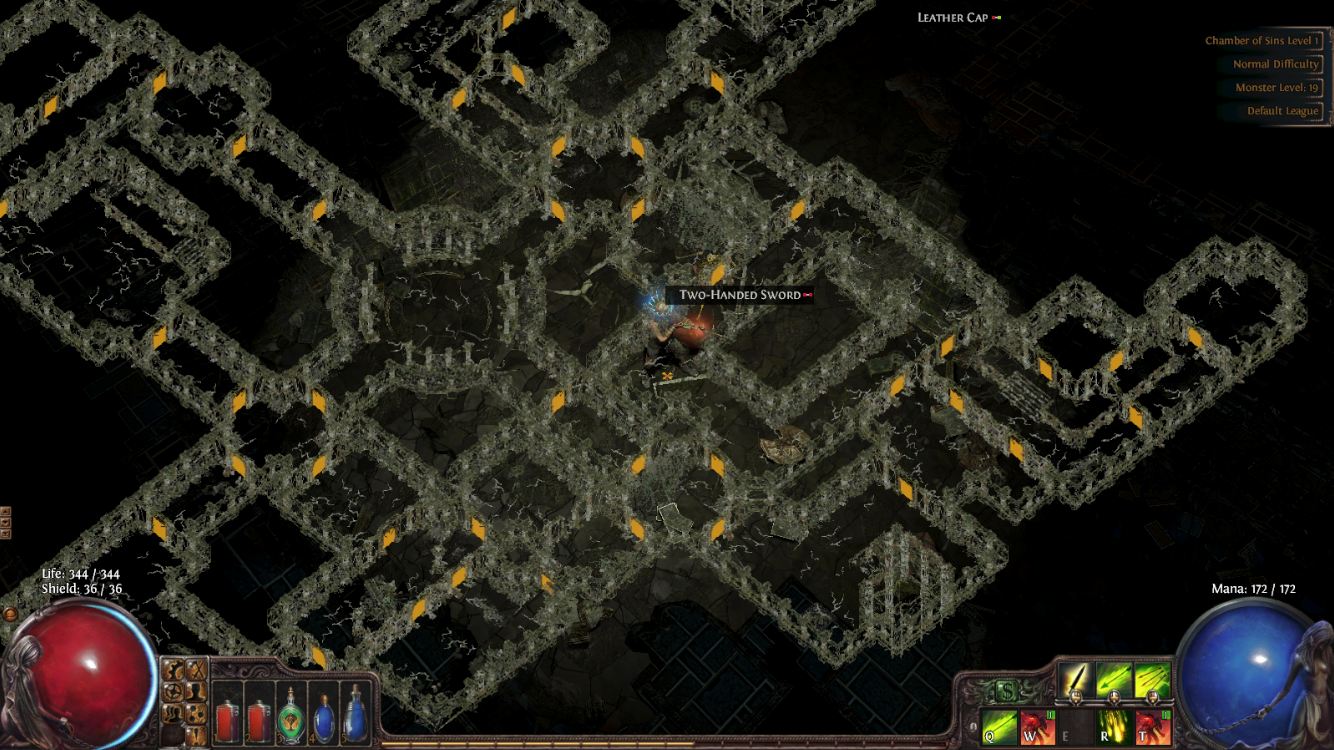 |
| Wanna know how big a map is? Check out the Chamber of Sins in Act 2 |
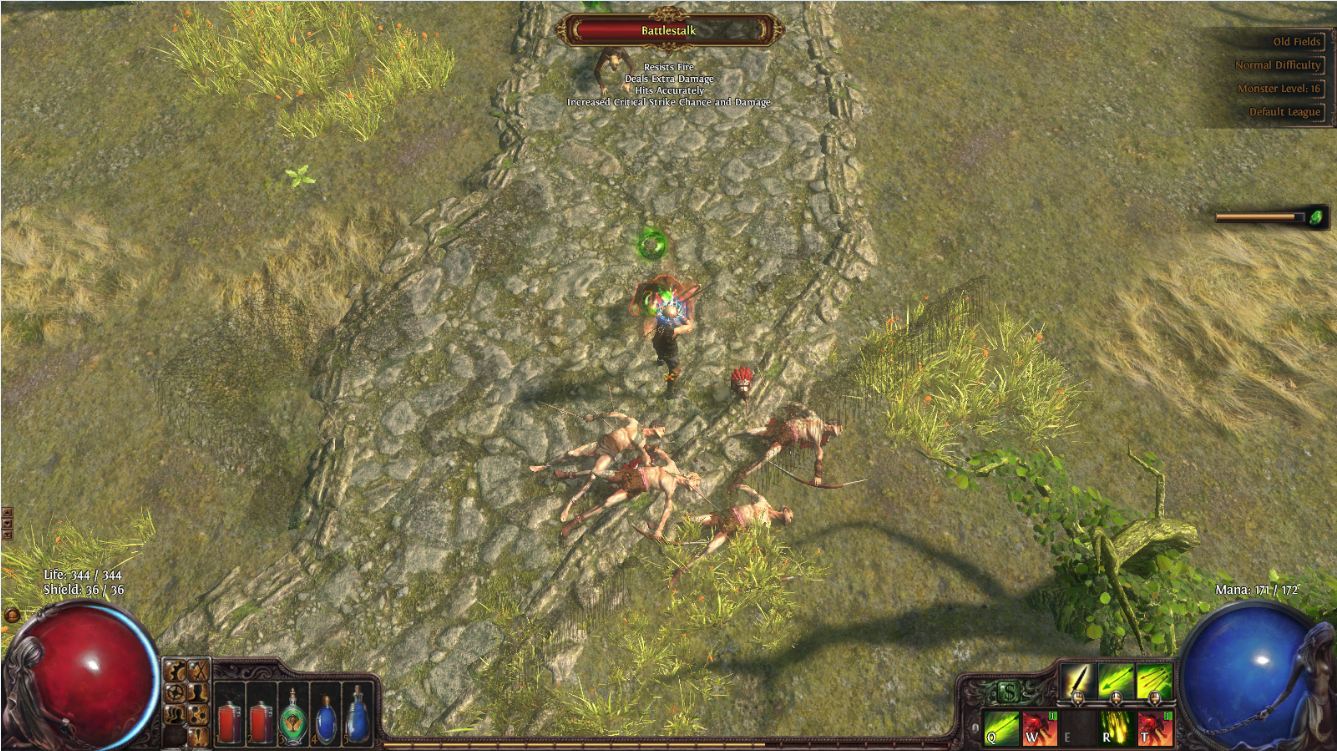 |
| A golden monkey. You'll see lots of these rare monsters everywhere you go. |
Gameplay
A beautiful game has nice graphics. But a good game must have good gaming mechanics. So how does Path of Exile handle as an ARPG? Well, it actually does a pretty decent job for now. Playing any class, players can get a feel of the amount of damage they are putting into every individual enemy. Graphics are beautiful for spells and the screen shaking when you land critical hits on enemies feels incredibly satisfying.
While fighting mechanics do stand out, this is only the tip of the iceberg. Weapons have different levels of rarity which is very similar to most other ARPGS with white weapons being common ones with nothing special about them to Unique weapons which are of the highest tier and are very powerful compared to all other weapons of its level. Weapons can also be enhanced by using a large amount of orbs which can alter the weapon in a huge variety of ways such as increasing its rarity or weapon quality for a slight boost in damage.
Skills are varied and work via gems you get when you finish quests or through random drops and weapons need to have the correct color of orb slot for the skill gem to be inserted. Weapons have different types of orb slots and so it adds more to the grind to find a good weapons with the right set of orb slots and equally useful effects. Skill gems are capable of gaining levels and becoming more powerful over time via killing monsters for experience. So what's the benefit of leveling up if all skills are embedded in gems? Well, you get a passive skill point in every level and you get to choose from an insanely huge passive skill tree. I won't bother putting a picture here because it is just way too huge to even fit into this screen. However, you can visit this link to see just how massive it is and how much the developers have carefully planned it.
At end game, it does not stop. Even after you finish all the three acts the game has to offer in all difficulty modes, the game offers end game maps which you can access, much like how Torchlight II has mapworks. The exception is that these maps are not purchased but instead drop from high level monsters around level 60+ and can even be enhanced to different levels of rarity using orbs with different rarities of maps creating different effects in the map.
Each area you enter is a solo instance for you and only you. It does refresh if you leave it alone for too long but while you are in an instance, no one except people you invite into a party can come into your map. Co-op gameplay can be quite fun as you watch the blend of different skills and work together to finish the game together.
No one makes a perfect game, however, and Grinding Gear Games is no exception. Enemy AI can sometimes be incredibly clumsy and death animations are not very exciting. Loot variety is also not big enough. Weapons actually only boil down to a few choices. Every ten levels or so, you get a new type of bow / dagger/ whatever weapon you are using. This is not the case in most other games and players will probably not be able to get used to this level of standardization and the lack of variety of actual loot; I certainly did not take well to it at first. Perhaps playing Torchlight II and Diablo III has spoilt me for choice, but I am also unable to get used to the inventory system in Path of Exile either which strongly follows Diablo II where different equipment takes up different amounts of space, causing inventory to be filled up very quickly. Skills are very standard and don't exactly have the most impressive selection. Co-op ganeplay does not have individual loot and people do have to fight for rares occasionally, leading to players becoming angry in public parties if they are not well organised. Effects are no doubt impressive, but I was hoping for more innovation or unexpected skills. Perhaps I am just being too demanding, but at the end of the day, the game is still in open beta and there is always room for improvement pre-launch and post-launch.
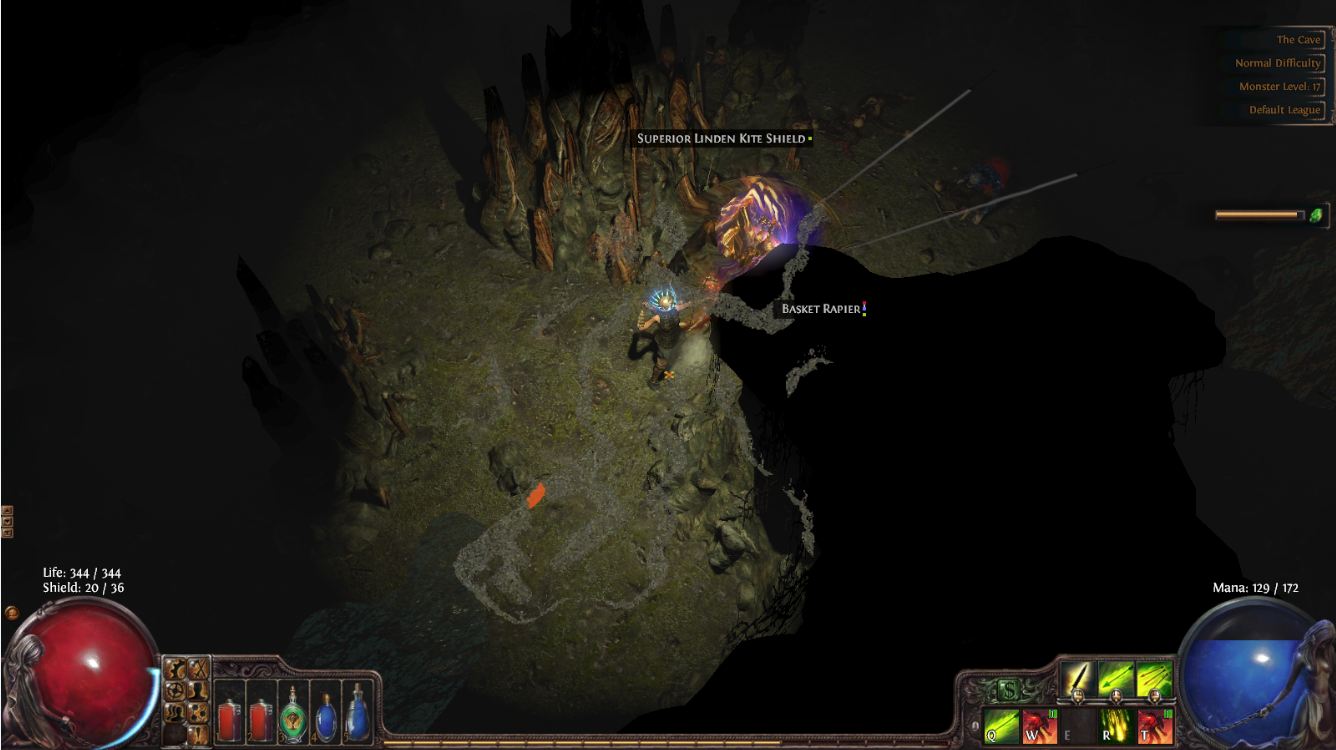 |
| Stacking elemental damage is fun to watch as enemies freeze and burn, either burning to death or being crystallized in ice and broken apart |
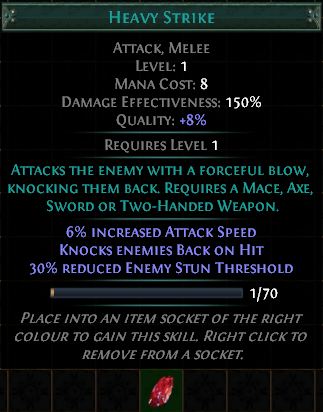 |
| A normal Melee class Gem |
At end game, it does not stop. Even after you finish all the three acts the game has to offer in all difficulty modes, the game offers end game maps which you can access, much like how Torchlight II has mapworks. The exception is that these maps are not purchased but instead drop from high level monsters around level 60+ and can even be enhanced to different levels of rarity using orbs with different rarities of maps creating different effects in the map.
Each area you enter is a solo instance for you and only you. It does refresh if you leave it alone for too long but while you are in an instance, no one except people you invite into a party can come into your map. Co-op gameplay can be quite fun as you watch the blend of different skills and work together to finish the game together.
No one makes a perfect game, however, and Grinding Gear Games is no exception. Enemy AI can sometimes be incredibly clumsy and death animations are not very exciting. Loot variety is also not big enough. Weapons actually only boil down to a few choices. Every ten levels or so, you get a new type of bow / dagger/ whatever weapon you are using. This is not the case in most other games and players will probably not be able to get used to this level of standardization and the lack of variety of actual loot; I certainly did not take well to it at first. Perhaps playing Torchlight II and Diablo III has spoilt me for choice, but I am also unable to get used to the inventory system in Path of Exile either which strongly follows Diablo II where different equipment takes up different amounts of space, causing inventory to be filled up very quickly. Skills are very standard and don't exactly have the most impressive selection. Co-op ganeplay does not have individual loot and people do have to fight for rares occasionally, leading to players becoming angry in public parties if they are not well organised. Effects are no doubt impressive, but I was hoping for more innovation or unexpected skills. Perhaps I am just being too demanding, but at the end of the day, the game is still in open beta and there is always room for improvement pre-launch and post-launch.
Business Model
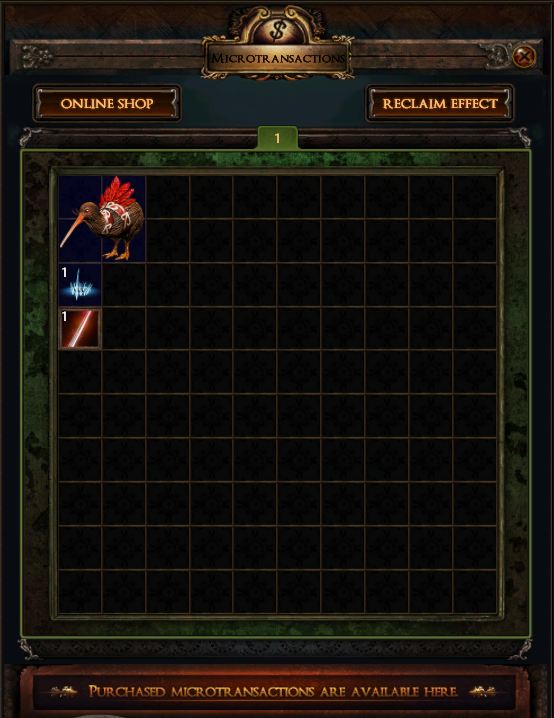 |
| Yes. I have a bronze kiwi for being a backer early last year and it is the cutest thing in the world aside from cats |
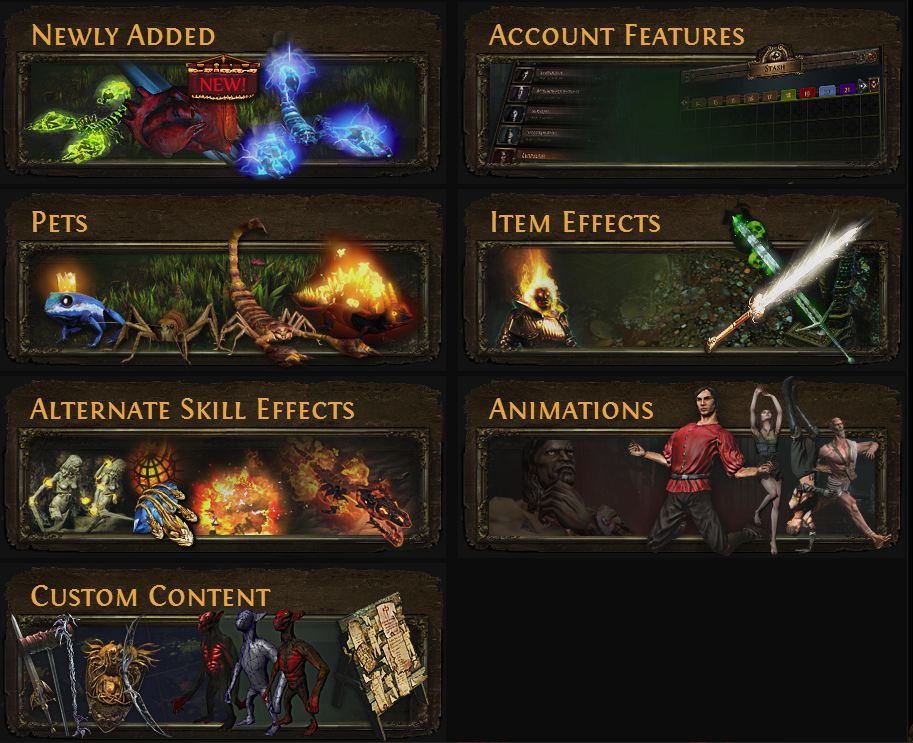
This is an example of how the online shop works. You purchase effects, they go into this area in your game. You can freely bind your item effect with any other item you wish to and if you are changing weapons, you can bring the item effect along with you. Pets can be summoned via right clicking and will follow you around absent-mindedly while you slaughter the undead horde.
Conclusion
Overall, Path of Exile demonstrates how the free to play ARPG model works (hopefully) and has the potential to become even better as the developers are busy churning out even more content waiting for its official release sometime later this year. However, it is in open beta for now. There's no harm trying the game. As said before, it is free so trying it doesn't cost a thing. You can visit their website here and take a look at some trailers and see the game in action for yourself. If it's not your type of game, all you need to do is uninstall. However, if you do end up liking it, you'll be immersed in a whole new world for months.