
BlackBerry Helps
Automakers Realize a Safe and Secure Connected Car
with
the Launch of QNX Hypervisor 2.0
Singapore, 9 June 2017 – BlackBerry
Limited (NASDAQ: BBRY; TSX: BB) is addressing safety and security, two
of the most important factors for next-generation connected and autonomous
vehicle software, with the launch of QNX®
Hypervisor 2.0. This real-time Type 1 Hypervisor based on QNX SDP 7.0, BlackBerry’s most advanced and
secure 64-bit embedded operating system, enables developers to partition and
isolate safety-critical environments from non-safety critical environments,
ensuring that no critical systems are put at risk.
 BlackBerry’s QNX Hypervisor 2.0 creates virtual software
containers, such that any hiccup or breach in a single car functional domain
can be isolated and does not impact or create vulnerabilities in other domains
of the car. One example is the virtual cockpit, which uses a single System on a
Chip (SoC) to run both an infotainment system and the car’s digital instrument
cluster, which comprises the speedometer, odometer and gas tank indicator. The
digital instrument cluster interfaces with critical driving systems, and thus
needs to be both safety certified and architected in such a way that security
is ironclad. With QNX Hypervisor 2.0, each of these two systems is isolated and
kept safe, so that if the infotainment system were to crash, it would not take
the safety-critical systems down with it.
BlackBerry’s QNX Hypervisor 2.0 creates virtual software
containers, such that any hiccup or breach in a single car functional domain
can be isolated and does not impact or create vulnerabilities in other domains
of the car. One example is the virtual cockpit, which uses a single System on a
Chip (SoC) to run both an infotainment system and the car’s digital instrument
cluster, which comprises the speedometer, odometer and gas tank indicator. The
digital instrument cluster interfaces with critical driving systems, and thus
needs to be both safety certified and architected in such a way that security
is ironclad. With QNX Hypervisor 2.0, each of these two systems is isolated and
kept safe, so that if the infotainment system were to crash, it would not take
the safety-critical systems down with it.“There is no safety without security,” said John Wall, senior
vice president and head of BlackBerry QNX. “If hackers can access a car through
a non-critical ECU system, they can tamper or take over safety-critical areas,
such as the steering system, brakes or engine. BlackBerry’s QNX Hypervisor 2.0
safeguards against these types of attacks and is a key component of our multi-level
approach to securing connected and autonomous vehicles.”
BlackBerry is also announcing that Qualcomm Technologies has
adopted QNX Hypervisor 2.0 as part of certain digital cockpit solutions.
Combining BlackBerry’s hypervisor with the high-performance compute and
connectivity capabilities of the Qualcomm® Snapdragon™ 820Am automotive
platform can support automakers to integrate the infotainment system and
instrument cluster using the same SoC. Support for QNX Hypervisor 2.0 on the
Snapdragon 820Am automotive platform is available for evaluation by Qualcomm
Technologies’ customers today.
“The QNX Hypervisor 2.0 will assist automakers in taking greater
advantage of the power of our Snapdragon automotive platform,” said Nakul
Duggal, vice president, product management, automotive, Qualcomm Technologies,
Inc. “The ability to run concurrent operating systems on top of the QNX
Hypervisor on the Snapdragon 820Am automotive platform will help automakers to
reduce hardware complexity and cost in their vehicles, while still delivering
the responsive and rich user experiences that consumers demand today in their
vehicles.”
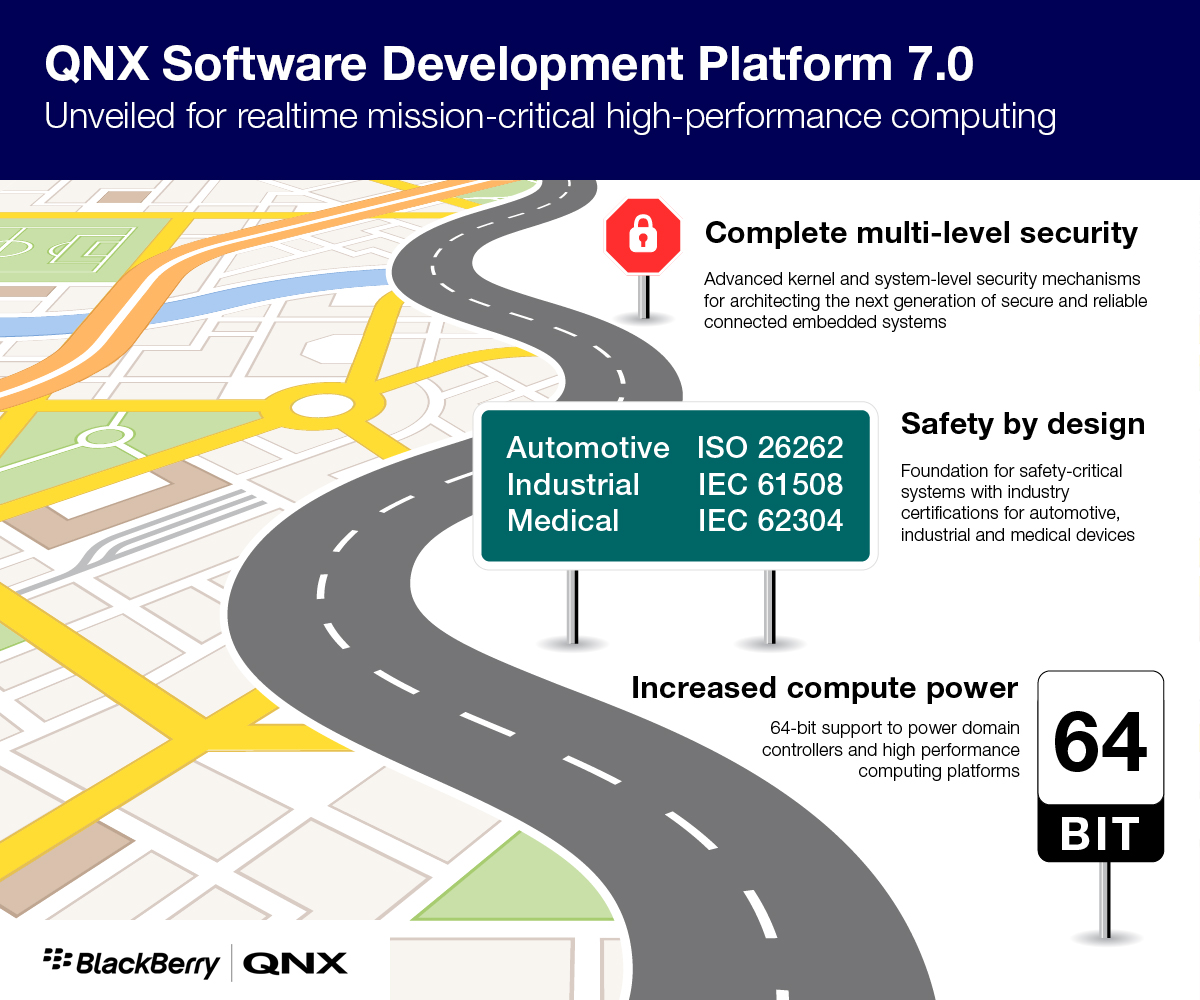
BlackBerry’s QNX Hypervisor 2.0 complies with IEC 61508 SIL 3
for industrial safety, IEC 62304 for medical device software, and ISO 26262 ASIL
D for automotive safety.
For the LATEST tech updates,
FOLLOW us on our Twitter
LIKE us on our FaceBook
SUBSCRIBE to us on our YouTube Channel!