
Gartner End-User
Survey Finds Three-Quarters of Respondents Are Willing to Pay More for 5G
Internet of Things
Communication Is Expected to Be the Most Popular Use Case
Singapore, 10 August, 2017 —
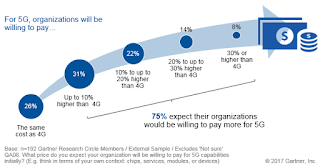
A recent global Gartner survey* revealed that 75 percent of end-user
organizations would be willing to pay more for 5G mobile capabilities (see
Figure 1). Only 24 percent of the survey's respondents would be unwilling to
pay more for 5G than for 4G.
"Those in the telecom industry are more likely to be
prepared to pay more than those in other industries," said Sylvain Fabre, research director at
Gartner. "End-user
organisations in the manufacturing, services and government sectors, for
example, are less likely to be willing to pay a premium for 5G than telecom
companies, which are willing to pay a 5G premium for their internal use."
Figure
1: How Much More Are End-User Organisations Willing to Pay for 5G Capabilities?

Source: Gartner (August 2017)
In addition to offering
better prices for industries in which users are less convinced of the business benefits of 5G, communications service providers (CSPs)
must create value propositions that entice
customers to start 5G
migration projects sooner.
Although most of the respondents think their organizations would
be prepared to pay more for 5G, few (8 percent) expect 5G to deliver cost
savings or increase revenues. 5G is seen principally as a network
evolution (59
percent), and only secondarily as an
enabler of digital business (37 percent). The survey also
found that respondents from the telecom sector are less persuaded than those in
other industries that 5G will be a revenue enhancer. "They tend to see 5G
migration as a matter of gradual and inevitable infrastructural change, rather
than as an opportunity to generate new revenue," said Mr. Fabre.
Internet of Things Communication as the No. 1
Use Case for 5G
The survey found that almost half the
respondents intend to use 5G to access videos and fixed wireless capabilities.
More interestingly, though, the majority respondents (57 percent) believe that
their organization’s main intention is to use 5G to drive Internet of Things (IoT)
communication.
"This finding is surprising, as the number of deployed 'things' that need
cellular connectivity won't exceed the capacity of existing cellular IoT
technologies before 2023 in most regions," said Mr. Fabre.
"And even once fully implemented, 5G will suit only a narrow subset of IoT
use cases that require a combination of very high data rates and very low
latency. In addition, 5G won't be ready to support massive machine-type
communications, or ultra-reliable and low-latency communications,
until early 2020." This finding may also be a sign of confusion
about 5G's applicability, as many proven and less expensive alternatives
already exist for wireless IoT connectivity — use of Wi-Fi, ZigBee or Bluetooth, for example, would avoid the cost and
complexity associated with cellular communications.
A degree of misunderstanding is probably also
apparent in the expressed belief by a large majority of the respondents (84
percent) that 5G will be widely available by 2020. By contrast, CSPs' plans
indicate that wide availability may not be achieved before 2022.
Gartner predicts that, by 2020, only 3
percent of the world's network-owning mobile CSPs will have launched 5G
networks commercially. "Although standards-compliant commercial network
equipment could be available by 2019, commercial rollouts of 5G networks and
services by CSPs before 2019 are likely to use prestandard equipment,"
added Mr. Fabre.
CSPs' marketing organizations need realistic roadmaps for 5G
coverage and typical performance, so that they communicate with customers
accurately. They also need to publish clear 5G rollout plans for the years 2019
to 2021 to help innovators understand when and where 5G will be available for
IoT applications.
Additional analysis is available in the
report: "User Confusion
About 5G Demands CSP Action."
About Gartner
Gartner, Inc. (NYSE: IT) is the world's
leading research and advisory company. The company helps business leaders
across all major functions in every industry and enterprise size with the
objective insights they need to make the right decisions. Gartner's
comprehensive suite of services delivers strategic advice and proven best
practices to help clients succeed in their mission-critical priorities. Gartner
is headquartered in Stamford, Connecticut, U.S.A., and has more than 13,000 associates
serving clients in 11,000 enterprises in 100 countries. For more information,
visit gartner.com.
For the LATEST tech updates,
FOLLOW us on our Twitter
LIKE us on our FaceBook
SUBSCRIBE to us on our YouTube Channel!