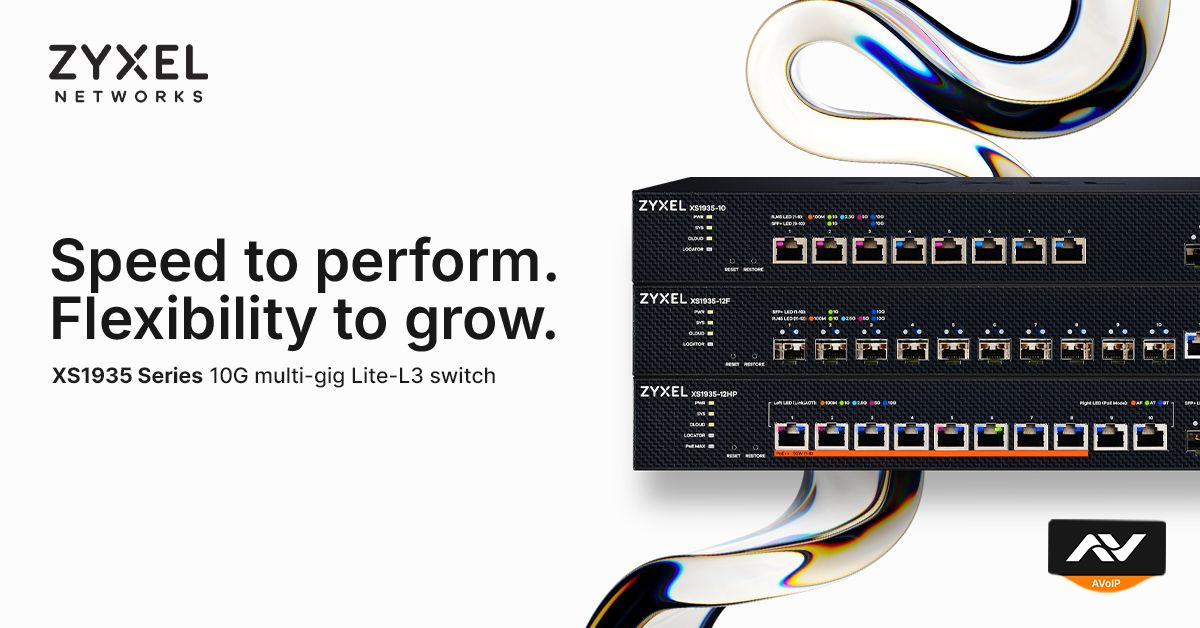
Zyxel Networks has introduced the XS1935 series, a family of compact managed switches intended to remove wired-network bottlenecks for small and medium-sized businesses. The range puts 10-gigabit connectivity on every port while retaining a choice between local administration and Zyxel’s Nebula cloud platform.
The series comprises three models: the XS1935-10, the PoE++-equipped XS1935-12HP and the all-fibre XS1935-12F. Zyxel has not announced regional pricing or a detailed market-by-market availability schedule, so prospective buyers will need to check the company’s local channels.
Three models for copper, powered devices and fibre
All ports across the XS1935 family support speeds of up to 10Gbps, according to Zyxel. The compact 10- and 12-port formats are aimed at networks connecting bandwidth-intensive equipment such as Wi-Fi 7 access points, servers, network-attached storage, IP cameras and professional AV-over-IP systems.
The XS1935-12F provides 10GbE fibre connectivity across every port. That makes it the aggregation and longer-distance option in the family, where optical links are preferable to copper or where a business needs to connect separate equipment locations.
For installations that need to power devices through the network cable, the XS1935-12HP supports PoE++ output of up to 90W per port and has a 400W total power budget. Zyxel cites Wi-Fi 7 access points, pan-tilt-zoom cameras, smart IoT hardware and video-conferencing systems as target devices. The available power for any one deployment will still depend on the combined load and the PoE requirements of each connected device.
NebulaFlex switches between local and cloud management
NebulaFlex allows administrators to operate an XS1935 switch in standalone mode or move it to Zyxel’s Nebula cloud management. The choice lets a small installation remain locally managed while giving organisations with several sites an option for centralised remote monitoring and configuration.
The standard Lite-L3 feature set includes virtual LANs, Quality of Service, link aggregation and Layer 3 static routing. Those controls can separate traffic, prioritise latency-sensitive applications and combine links, although their effectiveness will depend on the design and configuration of the wider network.
Zyxel is reserving advanced Layer 3 routing and a NetworkedAV mode for an additional Access L3 licence. Buyers considering the series for professional AV-over-IP deployments should therefore account for the licence as well as the switch hardware when comparing costs.
10GbE addresses the switch as a potential bottleneck
Multi-gigabit Wi-Fi access points and faster storage can exceed the capacity of older 1GbE switching infrastructure even when the endpoint hardware itself is performing normally. Moving every switch port to 10GbE gives the XS1935 family headroom for faster local file transfers and multiple high-bandwidth devices, but actual throughput will also depend on cabling, transceivers, endpoint interfaces, storage performance and traffic patterns.
The announcement does not include independent performance results, acoustic specifications, power-consumption figures or local warranty and support details. TTR has not tested the switches, so Zyxel’s performance and deployment claims should be treated as manufacturer specifications rather than measured results.
Packaging claim compared with the XS1930 generation
Zyxel also says the XS1935 uses redesigned packaging that cuts per-unit packaging-related carbon emissions by 30% compared with the previous-generation XS1930 series. The company says the calculation uses generic emissions factors. This is a claim about the packaging rather than the switch’s operating energy use or total lifecycle footprint.
Further specifications and availability information are provided on the official Zyxel XS1935 series page.
Source: Zyxel Networks press release dated 17 September 2026 and official product information. Product capabilities and environmental figures are manufacturer claims and have not been independently tested by TTR.