
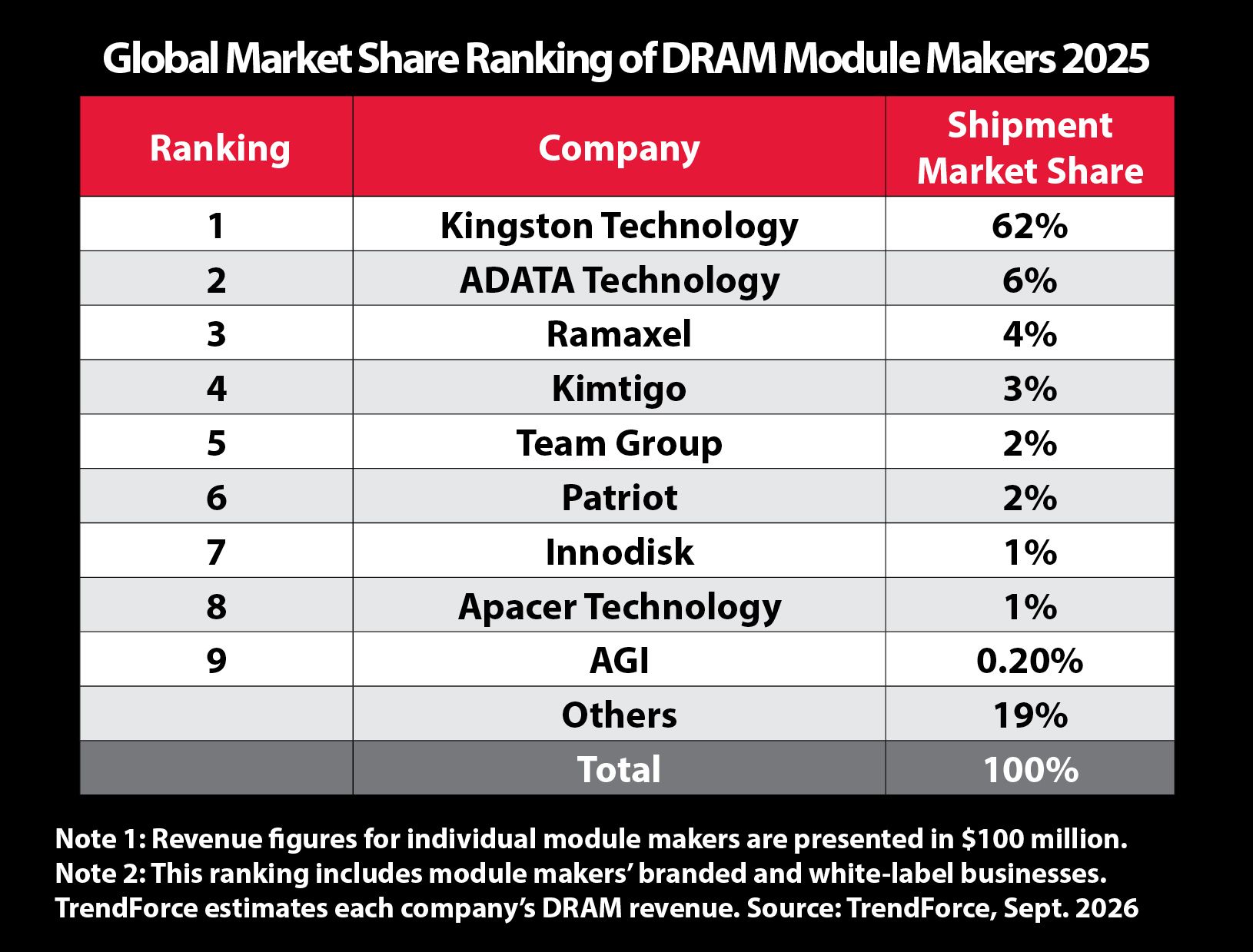
Kingston retained a commanding lead in the global third-party DRAM module market in 2025, accounting for an estimated 62% of revenue, according to TrendForce’s latest ranking.
The research firm estimates that worldwide DRAM module revenue reached US$21.2 billion for the year, up 59% from 2024. That was a sharp acceleration from the 7% growth recorded a year earlier, driven by higher memory prices and a concentration of module shipments in the second half of 2025.
AI-server demand reshaped the market
Market conditions changed markedly between the two halves of 2025. TrendForce says some module makers increased DDR4 inventories during the second quarter in response to tariff concerns and DRAM suppliers’ end-of-life plans for the older memory standard. PC makers and consumer-electronics companies also brought some purchases forward.
In the second half, cloud service providers in North America and China increased server DRAM orders to support agentic AI workloads. The added demand reduced the supply available for PCs and consumer products, pushing overall DRAM prices higher while module shipment volumes also increased.
The shift encouraged module suppliers to place greater emphasis on industrial and enterprise-server products. It also accelerated the move towards DDR5, which TrendForce says became the industry’s primary product line during the latter half of the year.
Kingston grew, but some smaller rivals expanded faster
Kingston’s DRAM module revenue increased 48% year on year. TrendForce attributes the company’s position partly to its procurement scale and inventory accumulated through 2024 and 2025, which left it able to supply the channel more aggressively as prices strengthened.
The ranking also shows that market growth was not evenly distributed. Second-placed ADATA increased revenue by 82%, while Ramaxel, in third, recorded 153% growth. Kimtigo and Team Group completed the top five. Together, those five suppliers represented 77% of market revenue; the top nine accounted for 81%.
Kingston says enterprise, data-centre and industrial customers have become an important part of its business as demand shifts towards servers and AI infrastructure. Its memory portfolio spans DDR4 and DDR5 products for client PCs, gaming systems, servers and embedded applications.
The figures are revenue-based estimates for third-party module suppliers, rather than a measure of all DRAM chip production. Samsung Electronics, SK hynix and Micron manufacture the underlying DRAM chips and are assessed separately from companies selling third-party memory modules.
Sources: TrendForce market report dated 22 September 2026; Kingston press release dated 1 October 2026.