The Taiwan Artificial Intelligence Association and Singapore AI Association have signed a memorandum of understanding intended to deepen cooperation after Tech Week Singapore 2026. The framework covers AI advisory services, exchanges of technical and market intelligence, enterprise and trade engagement, and support for small and medium-sized companies expanding across markets.
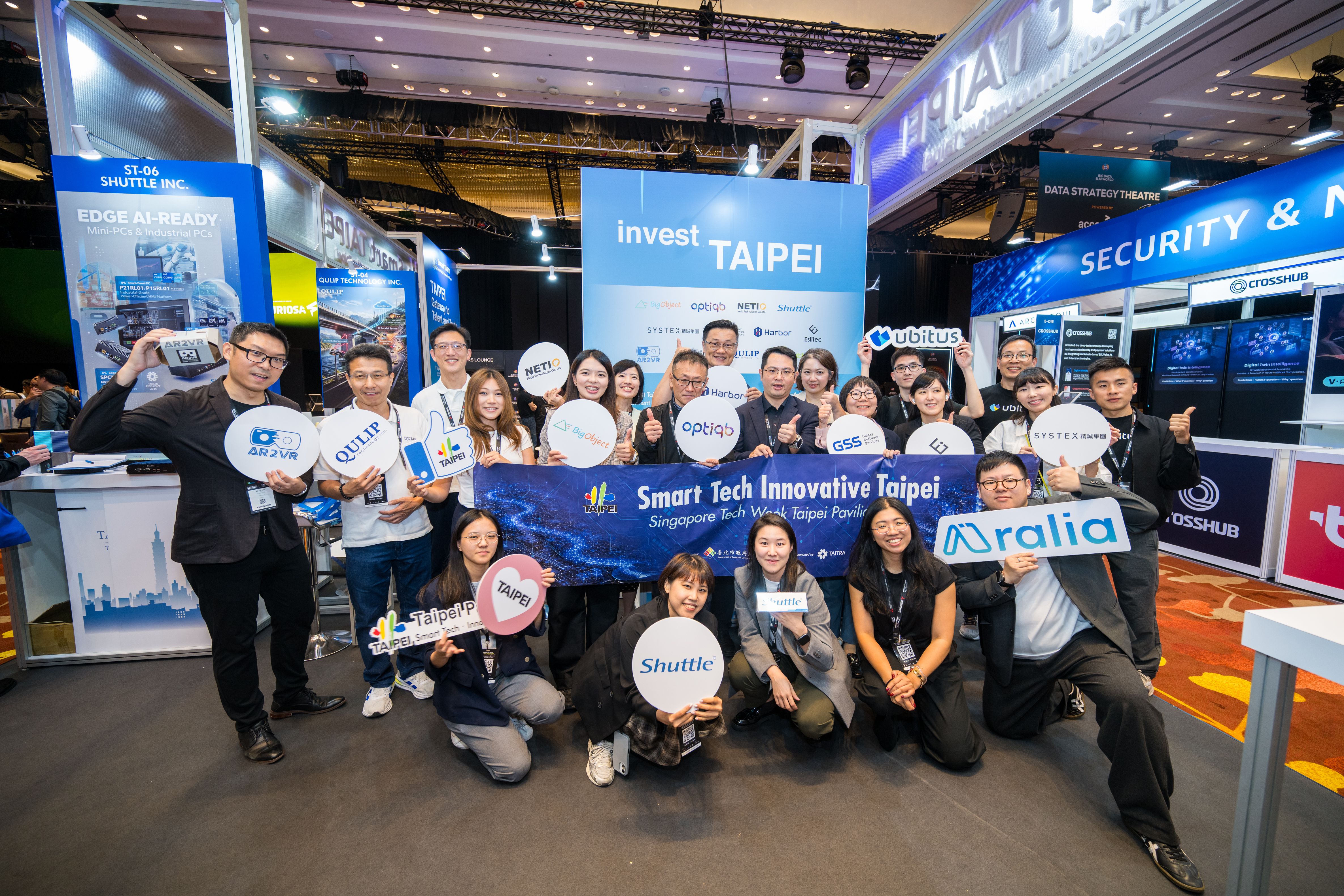
The agreement was presented as the main post-event outcome from the Taipei Pavilion, which brought 12 technology companies to Sands Expo and Convention Centre on 29 and 30 September. TTR previously covered the delegation in a pre-event preview; the new source packet adds the cooperation agreement and interviews about what enterprises need to move AI beyond pilot projects.

The MOU creates a framework, not a confirmed project
According to the post-event release supplied by the Taiwan External Trade Development Council (TAITRA), the two associations will identify opportunities for joint projects and future exchanges while connecting Taiwan’s technology suppliers with Singapore’s enterprise and innovation networks.
Jules Shih, a manager at TAITRA, described the two ecosystems as complementary: Singapore offers an established environment for enterprise deployment and access to Southeast Asian markets, while Taiwan contributes capabilities in semiconductors, hardware, edge computing and systems integration.
The announcement does not name a first joint project, participating customer, investment amount or implementation timetable. The MOU should therefore be read as an organising framework for future cooperation rather than evidence that a commercial deployment has already been secured.
Infrastructure and data remain the barriers to scaling AI
Interviews supplied with the release consistently shifted attention away from model performance and towards data, infrastructure and operating conditions.
Nina Lai, vice president at NETIO Technologies, said AI pilots often work within one organisation but become harder to replicate across ASEAN because languages, data quality, regulation and workflows differ between markets. In industrial environments, legacy machines and incompatible protocols can prevent operational data from reaching modern AI systems at all.
Lai argued that organisations should first connect and structure the relevant data, then decide what a system actually needs for each decision. Sending every available signal into a model can add latency and reduce accuracy. NETIO also sees local or on-premise processing as important where factories operate closed systems, sensitive information cannot leave the site, or cloud usage costs are difficult to predict.
BigObject director Jenny Pan made a related case around data sovereignty. She defined it not simply as where information is stored, but whether an organisation can control access, set permissions and trace how an AI agent uses its data. Pan proposed “AI Spaces” as a possible evolution of federated data-sharing frameworks, allowing agents to discover and use distributed information without requiring every participant to move data into one central repository.
These are vendor perspectives rather than independently verified deployment results. They nevertheless identify a practical constraint shared by many enterprise AI projects: agents cannot operate reliably if source data remains fragmented, poorly governed or inaccessible to the systems expected to use it.
Edge compute, sovereign infrastructure and usable experiences
The pavilion’s demonstrations covered both infrastructure and applications. NETIO and Shuttle presented industrial edge-computing systems, while SYSTEX focused on cybersecurity visibility, exposure management and risks created by unsanctioned “Shadow AI” use. Harbor Technology Solutions demonstrated equipment diagnostics that combine physical signals such as vibration, acoustics, electromagnetic measurements and images.
Ubitus director Bull Hsu said the transition from pilots to production increases demand for GPU capacity, low-latency processing and environments where organisations retain control over sensitive information. He cited healthcare, finance and interactive virtual characters as examples where infrastructure, data protection and response time can matter as much as the underlying model.
At the user-facing end, Optiqb AI Technology presented software that it says can convert conventional 2D content into glasses-free 3D in real time. Its approach combines software with a screen protector and eye tracking on existing phones, tablets or computers. The company positions Singapore as a test market and base for expansion into Thailand, Vietnam and Malaysia. TTR has not independently tested the visual quality, comfort or device compatibility of the system.
Singapore is being used as a regional decision-making hub
The interviews also showed that market entry is not simply a matter of exporting technology. Shih said TAITRA evaluates whether a product fits a market, whether its supplier can provide continued support and whether the company understands local business conditions.
Galaxy Software Services (GSS) sees Singapore as a route to regional headquarters and technology decision-makers. International channel manager Tina Shao said the company is looking to adapt its enterprise software experience—including cloud services, customer relationship management and carbon management—to Southeast Asian customers. One example is using AI within CRM systems to help staff retrieve institutional knowledge and shorten training time.
SYSTEX manager Phoebe Shih highlighted the importance of local partners as Taiwanese manufacturers expand into markets such as Malaysia. The company is pursuing regional opportunities in security monitoring, exposure management, assessments and employee-focused security programmes, but its interview did not disclose new customers or contracts from Tech Week Singapore.
The common theme is that Singapore can connect Taiwanese vendors with regional customers and partners, while successful expansion still depends on localisation, support capacity and evidence that products solve a defined operational problem.
What to watch after the event
The MOU gives the two AI associations a formal basis for exchanges and potential joint work. Its practical value will depend on what follows: named projects, participating enterprises, measurable deployments and sustained support for SMEs entering new markets.
For the 12 exhibitors, the next test is similarly concrete. Product demonstrations need to translate into pilots that address local data, governance, integration and security requirements, then into deployments with clear operational results. Until those outcomes are disclosed, the post-event material is best understood as a statement of direction and industry priorities rather than proof of regional-scale adoption.
Source: TAITRA post-event release dated 6 October 2026 and interviews supplied by Priority Consultants with NETIO Technologies, BigObject, Optiqb AI Technology, Ubitus, TAITRA, Galaxy Software Services and SYSTEX. TTR has not independently tested the products discussed.