Vertiv Anticipates Advent of Gen 4 Data Center in Look Ahead to
2018 Trends
Increased
reliance on the edge, importance of colocation providers driving developments

Singapore
[Dec.
5, 2017] – The next-generation data center will exist beyond walls, seamlessly
integrating core facilities with a more intelligent, mission-critical edge of
network. These Gen 4 data centers are emerging and will become the model for IT
networks of the 2020s. The advent of this edge-dependent data center is one of
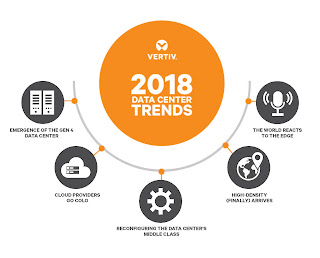
five 2018 data center trends identified by a global panel of experts from
Vertiv, formerly Emerson Network Power.
“Digital transformation has
driven tremendous growth in colo facilities as companies in Asia migrated
critical applications to the cloud over the last few years. This, coupled with
the explosion in connected devices and requirements for low latency and
seamless customer experience, has led to the need for re-architecting data centers
in the middle and at the edge,” said Anand Sanghi, president, Vertiv, Asia. “From
Australia to Singapore to Korea, in 2017 we now have over 50 use-cases for our
converged/edge SmartSolutions, enabling enterprises to harmoniously integrate
the cloud to the edge and architect their infrastructure to be agile,
efficient, always-on, and visible on a single pane.”
Previous Vertiv forecasts
identified trends tied to the cloud, integrated systems, infrastructure
security and more. Below are five trends expected to impact the data center
ecosystem in 2018:
- Emergence
of the Gen 4 Data Center: Whether traditional IT closets or 1,500
square-foot micro-data centers, organizations increasingly are relying on the
edge. The Gen 4 data center holistically and harmoniously integrates edge and
core, elevating these new architectures beyond simple distributed networks.
This is happening with innovative architectures delivering near real-time capacity in scalable, economical modules that leverage optimized thermal solutions, high-density power supplies, lithium-ion batteries, and advanced power distribution units. Advanced monitoring and management technologies pull it all together, allowing hundreds or even thousands of distributed IT nodes to operate in concert to reduce latency and up-front costs, increase utilization rates, remove complexity, and allow organizations to add network-connected IT capacity when and where they need it. - Cloud
Providers Go Colo: Cloud adoption is happening so fast that in
many cases cloud providers can’t keep up with capacity demands. In reality,
some would rather not try. They would prefer to focus on service delivery and
other priorities over new data center builds, and will turn to colocation
providers to meet their capacity demands.
With their focus on efficiency and scalability, colos can meet demand quickly while driving costs downward. The proliferation of colocation facilities also allows cloud providers to choose colo partners in locations that match end-user demand, where they can operate as edge facilities. Colos are responding by provisioning portions of their data centers for cloud services or providing entire build-to-suit facilities. - Reconfiguring
the Data Center’s Middle Class: It’s no secret that the
greatest areas of growth in the data center market are in hyperscale facilities
– typically cloud or colocation providers – and at the edge of the network. With
the growth in colo and cloud resources, traditional data center operators now
have the opportunity to reimagine and reconfigure their facilities and
resources that remain critical to local operations.
Organizations with multiple data centers will continue to consolidate their internal IT resources, likely transitioning what they can to the cloud or colos while downsizing and leveraging rapid deployment configurations that can scale quickly. These new facilities will be smaller, but more efficient and secure, with high availability – consistent with the mission-critical nature of the data these organizations seek to protect.
In parts of the world where cloud and colo adoption is slower, hybrid cloud architectures are the expected next step, marrying more secure owned IT resources with a private or public cloud in the interest of lowering costs and managing risk. - High-Density
(Finally) Arrives: The data center community has been predicting
a spike in rack power densities for a decade, but those increases have been
incremental at best. That’s changing. While densities under 10 kW per rack
remain the norm, deployments at 15 kW are not uncommon in hyperscale facilities
– and some are inching toward 25 kW.
Why now? The introduction and widespread adoption of hyper-converged computing systems is the chief driver. Colos, of course, put a premium on space in their facilities, and high rack densities can mean higher revenues. And the energy-saving advances in server and chip technologies can only delay the inevitability of high density for so long. There are reasons to believe, however, that a mainstream move toward higher densities may look more like a slow march than a sprint. Significantly higher densities can fundamentally change a data center’s form factor – from the power infrastructure to the way organizations cool higher density environments. High-density is coming, but likely later in 2018 and beyond. - The
World Reacts to the Edge: As more and more businesses shift
computing to the edge of their networks, critical evaluation of the facilities
housing these edge resources and the security and ownership of the data
contained there is needed. This includes the physical and mechanical design,
construction and security of edge facilities as well as complicated questions
related to data ownership. Governments and regulatory bodies around the world
increasingly will be challenged to consider and act on these issues.
Moving data around the world to the cloud or a core facility and back for analysis is too slow and cumbersome, so more and more data clusters and analytical capabilities sit on the edge – an edge that resides in different cities, states or countries than the home business. Who owns that data, and what are they allowed to do with it? Debate is ongoing, but 2018 will see those discussions advance toward action and answers.
For more information on these
trends and other insights from experts at Vertiv, visit www.VertivCo.com.
For the LATEST tech updates,
FOLLOW us on our Twitter
LIKE us on our FaceBook
SUBSCRIBE to us on our YouTube Channel!